

Dogs
Breed History
Standard
Album
Links
Guestbook
webdesign: Rita Szeydl
last update: 2010.09.25.
History of the breed
The Samoyed
History
The Origin of the Breed- The Samoyede People and Their Dogs
The People
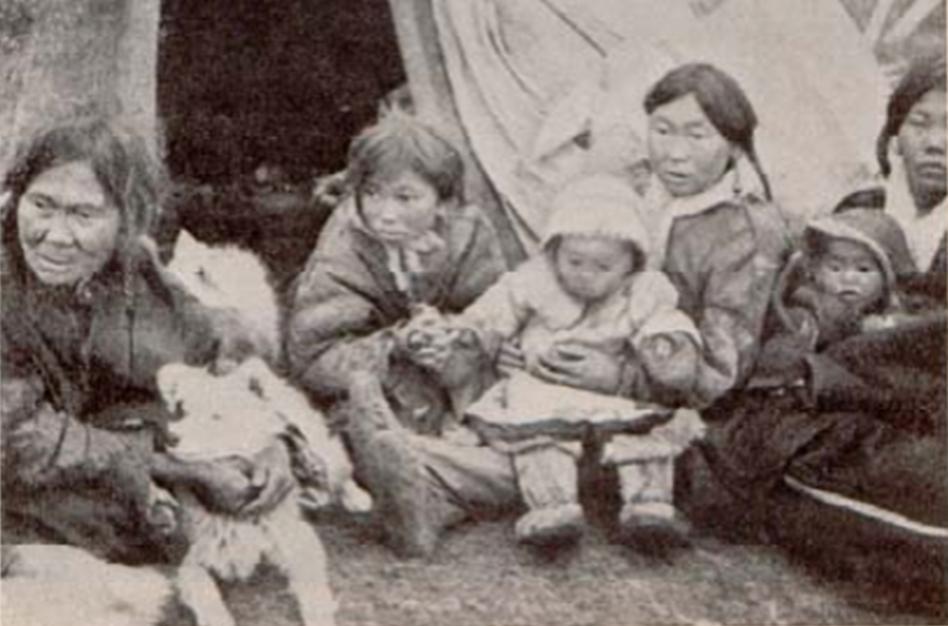 The name Samoyed comes from the Samoyedes, a semi-nomadic people of Asian decent. Historians tell us that, as the population of Asia grew, larger tribes drove others (with their families, their herds, and their dogs) away to other regions, so there would be enough natural food found for those remaining. The Samoyed peoples "of the family of Sayantsi" were part of this migration, and they moved northwest. In the late 1800's European exploreres and historians described them as a race in the transition stage between the “Mongol pure and the Finn”. The name "Samoyede" translates to "living off themselves" which reflects their strong, self-sufficient culture. The two principle Samoyede groups are the Nentsy and the Entsy.
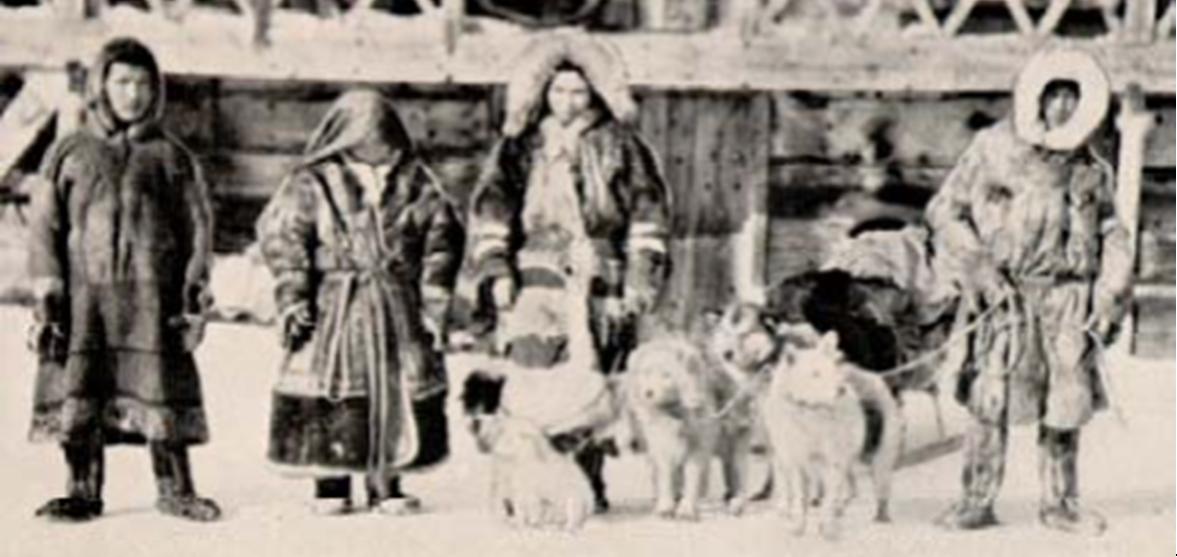 The Samoyede migrated to their current location in the first millennium and inhabited lands covered with snow and ice in the vast stretches of tundra reaching from the White Sea (an inlet of the Barents Sea on the northwest coast of Russia) to the Yenisei River (the greatest river system flowing to the Arctic Ocean). They lived mainly on the Taimyr Peninsula, between the Yenisei and Olenek rivers. This peninsula is in Northwestern Siberia north of the Arctic Circle jutting into the Arctic Ocean. It is the Northernmost part of the continent and is shown in the upper left hand corner of this map.
The Dogs
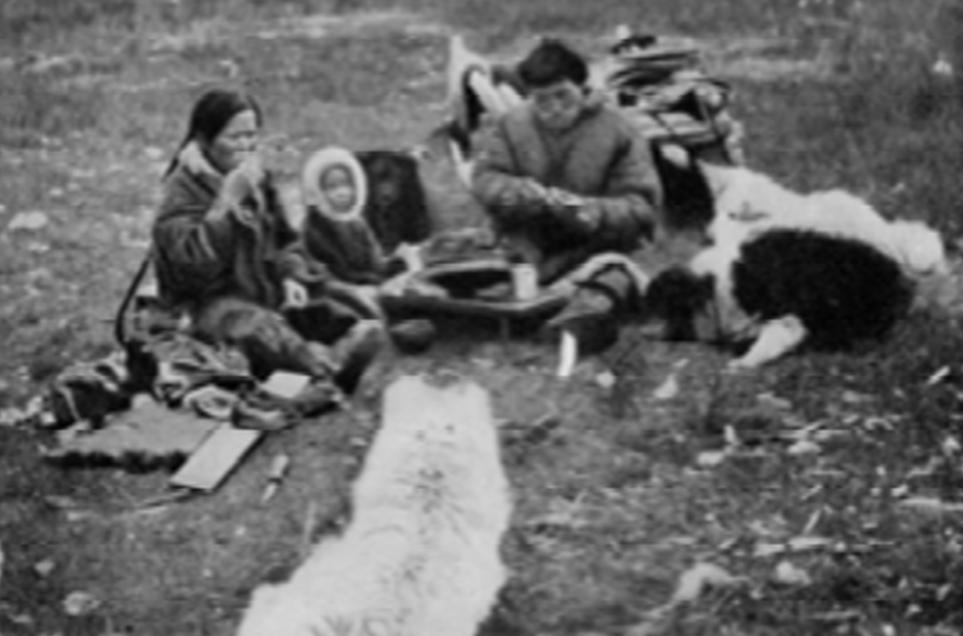 The first wolf-like canines (Canis familiaris palustris) appeared 12,000 to 14,000 years ago and originated from the Southern strain of the Gray Wolf in South Central Asia, where the Samoyed people originated. Early Asian hunter-gatherers demonstrated a special kinship to wolves because of their common social structure and hunting prowess. This relationship in the Samoyede culture was heightened to reverence due in part to the culture's traditional animistic religion (worship of animal spirits). They took puppies and gave them a special place in their lodgings ("chooms"). This relationship went from reverence to partnership. Both the hunter-gatherer and the wolf-like canine had many aspects of their clan/pack behavior that were identical. It is therefore easy to see how the primitive canines adapted well to the similar social structure of the Samoyede people.
Due to their isolation from the rest of the world, the Samoyed dog "bred true, " meaning that there was no alteration of the breed from other wolf, fox, or primitive dog breeds. As a result, the Samoyed dog of today is one of only 4 breeds that are directly decsended from wolves. 1
The Samoyede people call their dogs "bjelkier" (byel-kee-er) which translates to "white (dog) that breeds white." In Russian, the dogs are called "voinaika" which means lead or direction dog. The Samoyedes incorporated their dogs into every aspect of their daily lives and trained and depended on them year round for hunting, herding, guarding, and as sledge (sled-pulling) dogs. Their dogs were considered part of their family. They included them in meals and even brought them in to sleep (especially with the children) for warmth on cold Arctic nights. The Samoyede so trusted their dogs that they would leave them to guard their children and posessions (including their valuable reindeer) while they were out hunting.
For generations the Samoyede people have lived a nomadic life, dependent upon their reindeer herds and their dogs. The Samoyede's lifestyle has always revolved around reindeer, which they used for food and their skins for clothing and shelter (a round-topped tent called a "choom"). As the Samoyede people domesticated the reindeer, they moved from a hunting, to a herding lifestye. Herding the domesticated reindeer was another useful service that came naturally to their dogs. The natural attribute of a wolf-like canine to go after an animal (prey drive) that breaks from the herd made it easy to use that behavior to herd the Reindeer. The Bjelkier could herd, haul and hunt. and it enjoyed doing all three.
The Samoyede and their dogs people exist today, although their numbers are less than 50,000. They are scattered across Siberia and have struggled to maintain their culture as industrialization expands throughout Siberia.
The Samoyed Is Brought to Europe
Arctic Explorers
How the Samoyed dog came from Siberia to Europe and eventually the US, is a romantic one and took place within a very short period of time- between the early 1890's and 1917. European explorers to Siberia brought back some of these beautiful, healthy, friendly dogs. The "Samoyed dog" quickly became sought-after gifts for Russian Czars and European royalty.
England and Russia
Queen Victoria's family spread across Europe and into Russia, where her daughter Alexandra married Czar Nicholas II. The Prince of Wales (later to become King Edward VIIl) was brother to Alexandra. Alexandra send her brother presents of Samoyed dogs. The Prince was so enamored of the breed that he went on to show several between 1890 and 1900. In 1888 a picture drawn to celebrate their Silver Wedding shows a Samoyed sitting at the feet of the Prince and Princess of Wales. Paintings of Samoyeds are still in the present Queen's art collection. After World War I (1917) very few Samoyed stock were exported out of Russia due to the Communist Revolution that effectively shut down the borders. Unfortunately, most of the Samoyeds kept by royalty were killed in the Russian Revolution. So by 1917, whatever stock was available in England, America, and other European nations was all that was used. The breed had attained Royal status and was "protected from outsiders."
Polar Expeditions
Fortunately, the Samoyed breed's strength, work ethic and temperament made them a choice for Polar expeditions (which were approved and largely funded by royalty). Norwegian explorer and Nobel Peace Prize winner Fridtjof Nansen (1861 -1930) is credited for bringing the Samoyed dog into the civilized world. Ironically, he did this by using "bjelkiers" (Samoyed dogs) in his expeditions throughout the largely incivilized Arctic regions, and in his several attempts to reach the North Pole. Despite brutal conditions, Nansen's 1895 expedition, which as lead by a team of bjelkiers was a success that was made headline news worldwide. Although he didn't reach the North Pole, he traveled further north than any other human had at that time. And the glowing reports he sent to other explorers about the "bjelkier's" heroic performance made them the dog of choice for several of the Arctic and Antarctic expeditions that followed. One of the most famous of these expeditions was Roald Amundsen 1911 expedition to the South Pole. Amudsen used Samoyeds as his lead dogs. While Amundsen is credited for being the first to reach the South Pole, surely his Samoyeds reached it before he did! Samoyeds were also the favored dogs of famous explorers Carsten Egeberg Borchgrevnik (1864-1934), Duke Hertog van Abruzzi (1873 - 1933) (the brother of the King of Italy), and Frederick Jackson (1860 - 1938).
Samoyeds- The Explorers' Dog of Choice
Because the dogs selected for use on these expeditions often meant the difference not just between success and failure, but between life and death, Nansen conducted extensive research prior to his expedition. It was through this research that he discovered the value of, and ultimately selected, Samoyed dogs for his many expeditions. Physically, the Samoyed has the most efficient design of the Nordic breeds, with a more pronounced double-layer coat than other nordic breeds. The long outer coat is soil and water repellent, so the dog can easily shake off snow and dirt. The inner coat is woolly and so thick that practically nothing can get through to its skin, both keeping the dog warm, and eliminating skin injuries. Deep brown eyes are set behind almond-shaped, black eyelids to reduce glare from snow. The Samoyeds' toes spread wide to provide extra traction, like a built-in snowshoe. The curved long, fluffy tail keeps the hips warm when running and covers the nose while sleeping during extreme temperatures, acting as a filter to warm and humidify the inhaled air. Their V-shaped chests support the dog's strong musculature, large heart/lung capacity, and dense bones which all provide extra hauling capacity without sacrificing agility. As importantly as their physical capabilities, Nansen valued their temperaments. He wrote often of how the Samoyed surpassed other breeds in determination; focus; endurance; and the instinctive drive to work in any condition. He also valued their equal and strong abilities to hunt, pull, and herd. But what really set the Samoyed apart from the rest was the fact that the dog's motivation for all they do is to please their human pack leaders. In the life-threatening situations present in expeditions, that is the combination he wanted. Sadly, even with all these atttributes, few dogs survived these grueling expeditions. However, those who did, became the strong foundation of the bloodlines of today's Samoyed. Clara and Ernest Kilburn-Scotts The Scotts are recognized for almost singlehandedly bringing us the Samoyed we know today. Ernest Kilburn Scott was a timber merchant, a scientist, engineer and was a man of wealth. As a result, he traveled extensively for work and pleasure, including several expeditions to the regions of the Samoyede people, where met his first "bjelkier." In 1889, Ernest Kilburn Scott had accompanied a Royal Zoological Society expedition to Archangel, Russia, where he purchased a puppy from the Samoyede people puppy. The puppy was mostly brown with white spots on his chest, paws and tail. He named the puppy Sabarka and brought him back to England. In 1892, The Scotts were the first to exhibit a Samoyed in a dog show, and created a stir as the dog took second place at the Leeds Dog Show. It was the first time a Samoyed had ever been seen in England. In 1893 a crew member of a timber freighter brought a cream colored bitch from Siberia to London and sold her to Mr Scott. He named her "Whitey Petchora". Others were imported in the 1890s. One, an all white one called " Musti " from West Siberia was brought in by Captain Labourn Popham and was photographed and Kilburn's printing on the photo read "Imported 1894" and "The type I Want." The Kilburn Scotts are largely credited with the breeding for the white coat we see today in Samoyeds, as that was their preference. In 1899, Scott purchased 8 other Samoyeds from fellow enthusiast and explorer Frederick George Jackson, who had used Samoyeds in his expedition to Fanz Josef Land. In 1909, the Scotts also acquired one of the world's most famous Samoyeds, Antarctic Buck. Buck was the lead dog for the 1899 expedition of veteran explorer Carsten Egeberg Borchgrevnink. He became so popular that he spent several years at a zoo in Sydney, Australia before being purchased by the Scotts. Buck was brought to England in 1909 where he sired several litters. Also in 1909, Kilburn Scott and Frederick George Jackson worked together to develop the first breed standard and founded the Samoyed Club. By 1912, The Kilburn Scotts had 50 dogs, which they sold to fans and explorers alike. Between 1892 and 1912, a number of the Scotts' Samoyeds were exported to the US where they became America's foundation breeding stock. In 1920, Ernest Kilburn Scott left family and dogs and moved to the US. Clara continued the breeding program in England alone. According to international writings of fanciers of the breed, many have developed strains in the breed, but Clara is credited for building the breed. Many believe that while Ernest brought home many of the foundation stock, it was Clara was the driver of the breeding program. In addition, Mrs. Kilburn-Scott is credited for fostering the admiration and recognition for the breed around the world. It could be said then, that Mrs. Kilburn-Scott's career, then, is the career of the Samoyed fancy.